Quantcast
feat0

Positive Pinoy: my personal journey with HIV.

I was diagnosed last March 29, 2012 in a time that I was supposed to leave the country in a couple more weeks. I had my medical exam, and the result returned POSITIVE. From then on, my journey with HIV began.

Read More
feat2

What's New?: gateway to useful links on local and international news and updates about HIV.

A summary collection of medical articles, research news, and science breakthroughs on HIV/AIDS, STIs, and other related diseases.

Read More
feat3

HIV 101: Basic information for the newly-diagnosed.

Understand the basics, know the facts, and take care of yourself. This section contains basic information about HIV/AIDS.

Read More
feat4

Social Media: going viral against HIV/AIDS and other STIs.

The entrance of social media in spreading awareness about HIV/AIDS has gone viral. Famous personalities and the common man alike showed their support not just to HIV education but also with regards to the lives and struggles of the LGBT community.

Read More
feat5

Health Events: listing of wellness and advocacy events for HIV-positive individuals and friends.

This section contains a summary listing of knowledge-sharing events on HIV, mass HIV testing, and other wellness events that will strengthen the overall health of HIV-positive individuals.

Read More

65) April 2013 --- Philippine HIV and AIDS Registry


Newly Diagnosed HIV Cases in the Philippines


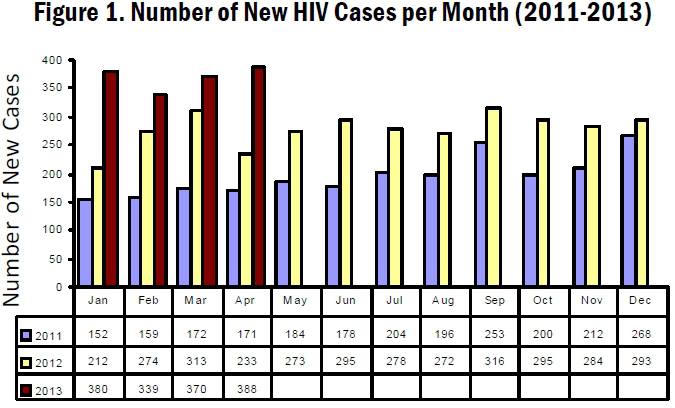
In APRIL 2013, there were 388 new HIV Ab sero-positive individuals confirmed by the STD/AIDS Cooperative Central Laboratory (SACCL) and reported to the HIV and AIDS Registry. This was 67% higher compared to the same period last year (n=233 in 2012).

Most of the cases (95%) were males. The median age was 28 years (age range: 17-63 years). The 20-29 year (61%) age group had the most number of cases.

Reported mode of transmission were sexual contact (356) and needle sharing among injecting drug users (32). Males having sex with other males (81%) were the predominant type of sexual transmission. Most (94%) of the cases were still asymptomatic at the time of reporting.

In April 2013, bulk of the new HIV cases came from NCR, Region 4A, Region 7, Region 11, and Region 3. The three highest reporting regions were NCR, 4A, and 7.


Source: Philippine HIV and AIDS Registry
www.pnac.org.ph/uploads/documents/publications/NEC_HIV_April-AIDSreg2013.pdf


64) March 2013 --- Philippine HIV and AIDS Registry


Newly Diagnosed HIV Cases in the Philippines


In MARCH 2013, there were 370 new HIV Ab sero-positive individuals confirmed by the STD/AIDS Cooperative Central Laboratory (SACCL) and reported to the HIV and AIDS Registry. This was 18% higher compared to the same period last year (n=313 in 2012).

Most of the cases (96%) were males. The median age was 28 years (age range: 17-63 years). The 20-29 year (55%) age group had the most number of cases.

Reported mode of transmission were sexual contact (364) and needle sharing among injecting drug users (6). Males having sex with other males (85%) were the predominant type of sexual transmission. Most (97%) of the cases were still asymptomatic at the time of reporting.

For March 2013, bulk of the new HIV cases came from NCR, Region 4A, Region 7, Region 3, and Region 11. The three highest reporting regions were NCR, 4A, and 7.


Source: Philippine HIV and AIDS Registry
www.pnac.org.ph/uploads/documents/publications/NEC_HIV_March-AIDSreg2013.pdf


63) February 2013 --- Philippine HIV and AIDS Registry


Newly Diagnosed HIV Cases in the Philippines


In FEBRUARY 2013, there were 339 new HIV Ab sero-positive individuals confirmed by the STD/AIDS Cooperative Central Laboratory (SACCL) and reported to the HIV and AIDS Registry. This was 24% higher compared to the same period last year. 

Most of the cases (96%) were males. The median age was 27 years (age range: 18-58 years). The 20-29 year (60%) age group had the most number of cases.

Reported mode of transmission was sexual contact (339). Males having sex with other males (82%) were the predominant type of sexual transmission. Most (93%) of the cases were still asymptomatic at the time of reporting.

In February 2013, bulk of the new HIV cases came from NCR, Region 4A, Region 3, Region 11, and Region 7. The three highest reporting regions were NCR, 4A, and 3. 


Source: Philippine HIV and AIDS Registry
www.pnac.org.ph/uploads/documents/publications/NEC_HIV_Feb-AIDSreg2013.pdf


62) Baguio General Hospital and Medical Center notes increase in HIV-AIDS patients


THE Department of Health (DOH) revealed an increase of patients with human immunodeficiency virus (HIV) being treated at Baguio General Hospital and Medical Center (BGHMC).

Dr. Maria Lorena Santos, BGHMC chair of HIV and Acquired Immunodeficiency Syndrome (AIDS) Core Team, said that there are now 72 HIV cases recorded from 2006 until May of this year. These cases were recorded at BGHMC.
She said the hospital had three cases each in 2006 and 2007 while six cases each in 2008 and 2009. Five patients were found HIV positive in 2010 at BGHMC.
However, the number increased in 2011 wherein the hospital had 16 HIV positive patients. The number continues to increase in 2012 with 17 patients while this year has already 16 confirmed patients to be positive of HIV from January to May only.
Despite the increase, Santos said DOH authorities are even happy with the numbers because it only implies that patients are now revealing themselves to doctors which will facilitate easy monitoring. Santos further said it is now easy for them to conduct counseling to the HIV patients. Treatment is also easy with the patients coming out availing of the health benefits the government offers.
Santos said the client–initiated counseling now will help the patients a lot to slow down the progress of the illness to AIDS.
The HIV and AIDS core team chairman said among the 72, the youngest victim is 19 years old while the oldest is 56 years old. BGHMC record shows that 51 are males while 21 are females. Among the 51 males, 40 are homosexual, eight are heterosexual, and three are bisexual. On the other hand, among the 21 females, 14 are heterosexual and one is bisexual.
Among the origins of HIV positive patients are: five from Manila; 28 from Baguio City; one each from Abra, Pampanga, and Isabela; and five from Benguet. Santos revealed most of the patients are professionals.
“HIV has no cure. All HIV positive patients will ultimately progress to AIDS,” she said.
The hospital executive also advised public to take extra precautions when having sexual intercourse with somebody. She revealed that four main source of HIV are: unprotected multiple sexual intercourse; blood transfusion; mother to child transmission; and sharing of injectable needles.
She also urges a person with HIV illness to inform his partner on his disease before sexual intercourse because it is mandated under the Philippine law. She explains, if the partner was informed about the illness and yet, he still want to have sex with the patient, that is his choice. However, Santos said the two can still have sex but they have to use protective measures in order to avoid transmitting the illness to one another’s future partner.
DOH encourages citizens with HIV symptoms to visit any hospital in order to avail of the free medicines, free laboratory tests, and other free health services which are now being offered to HIV victims.

Source: Rubyloida Bitog
http://www.sunstar.com.ph


61) 'Worse than AIDS' - sex 'superbug' discovered in Japan


Doctors are warning that a drug-resistant strain of gonorrhea could be more deadly than AIDS, and are urging members of US Congress to spend $54 million for the development of a drug that would fight it.

"This might be a lot worse than AIDS in the short run because the bacteria is more aggressive and will affect more people quickly," Alan Christianson, a doctor of naturopathic medicine, told CNBC.
The new strain of gonorrhea, H041, was first discovered in 2009 after a sex worker fell victim to the superbug in Japan. Medical officials reported that the medication-resilient ‘sex superbug’ was discovered in Hawaii in May 2011, and has since spread to California and Norway, the International Business Times reports.
Nearly 30 million people die from AIDS-related causes each year, and the H041 superbug could have similar consequences, according to Alan Christianson, a doctor of naturopathic medicine.
"Getting gonorrhea from this strain might put someone into septic shock and death in a matter of days,"Christianson said. "This is very dangerous."
The gonorrhea strain has not yet claimed any lives, but the US Centers for Disease Control and Prevention (CDC) have asked Congress for $54 million to find an antibiotic to treat the strain.
In a Capitol Hill briefing last week, health officials said an education and public awareness campaign is crucial in minimizing the effective of HO41. William Smith, executive director of the National Coalition for STD Directors, said that if the ‘sex superbug’ spreads, it could quickly kill many people before a treatment is discovered. And that risk becomes increasingly more likely if Congress does not provide the funds to find a cure, he said.
"It's an emergency situation. As time moves on, it's getting more hazardous," he told members of Congress.
"We have to keep beating the drum on this," he added. "The potential for disaster is great."
In the United States, there are 20 million new STD infections each year, which results in about $16 billion in medical costs, the CDC reports. More than 800,000 of these cases gonorrhea infections, most of which occur in young people ages 15 to 24. Gonorrhea is sometimes difficult to detect, since it shows no symptoms in about half of all women. Those who fall ill to the deadly strain may not notice it until it’s too late.
“That’s what’s kind of scary about this,” Smith said.
Although health officials have widely reported that cases of H041 were discovered in California, Hawaii and Norway, the CDC has disputed those claims and told CNBC on Monday that the infection has not been confirmed anywhere outside of Japan. The CDC did, however, make an announcement in 2011 that it was noticing greater gonorrhea bacterial resistance to certain types of antibiotics in Hawaii and California. 
CDC officials said that the US and Norwegian cases were treated effectively with antibiotics not routinely recommended and that these cases were mistakenly identified as H041. But the agency continues to urge Congress for research funding, indicating that the risk of infection is high regardless of where the cases occurred.
Christianson is urging people to practice safe sex and get STD tests if they are in a new relationship, since a superbug infection could be around the corner.
"This is a disaster just waiting to happen," he told CNBC. "It's time to do something about it before it explodes. These superbugs, including the gonorrhea strain, are a health threat. We need to move now before it gets out of hand."

Source:
http://rt.com/news/superbug-gonorrhea-aids-sex-900/


60) Fil-Am scientist joins TIME 100 for HIV breakthrough --- Rappler.com


MANILA, Philippines - President Benigno Aquino III wasn't the only person of Filipino descent in this year's TIME 100 Most Influential People list.
Filipino-American Katherine Luzuriaga, one of the 3 scientists who reported the first ever recorded "functional cure" in an infant with HIV, was also honored by the magazine in its annual list.
Luzuriaga, a professor of pediatrics and medicine at the University of Massachusetts Medical School, was cited by the magazine under its "Pioneers" list, along with fellow doctors Deborah Persaud and Hannah Gay, for their breakthrough in HIV/AIDS research.
She has been one of the world's leading scientists dealing with pediatric HIV/AIDS research, having been involved in the said field for more than two decades.
"These three women are responsible for orchestrating an incredible breakthrough: functionally curing a newborn of AIDS," Mark Dybul, executive director of the Global Fund to Fight AIDS, Tuberculosis and Malaria, wrote in the group's citation.
Breakthrough
Their study involved a baby born in a rural Mississippi hospital back in 2010, whose mother was HIV-positive. The infant was given a regimen of AIDS drugs from shortly after birth until 18 months. Five months after end of treatment, the baby was already HIV-negative.
The child, who is now 2 1/2 years old, is still HIV-free. The development surprised the world, and gave hope for thousands of HIV-positive babies worldwide.

When the TIME 100 list was released, Filipinos were abuzz only about Aquino's inclusion in it, primarily because her being Fil-Am was not explicitly stated in the magazine (TIME even lists Caracas, Venezuela as her birthplace).
The FilAm magazine was the first to report about her Filipino roots in an interview published Thursday, April 25.
Her father traces his roots to Bacolod City, the magazine said. Luzuriaga, on the other hand, grew up in Manila, and is an alumna of the International School. She then went on to study at the Massachusetts Institute of Technology (MIT) and Tufts University.
"We consider this a great achievement," she told the magazine during the TIME 100 gala in New York City, adding that it is an honor "to have our work considered to be of great influence. To a scientist, that means a lot." The 3 scientists, along with dozens other honorees, were feted at the event.
Luzuriaga said their work on HIV/AIDS research will continue. "One of the things about the finding is that it points the way to new studies that we can do and we’d like to go on and continue to make progress again for pediatric HIV infection," she told The FilAm.
"Together, we are committed to eradicating pediatric HIV infection and improving child health globally,"she said in a statement shortly after the list was announced.
The list, published annually by the magazine since 2003, is a rundown of some of the world's most influential individuals, from the arts to politics to science. - with reports from KD Suarez/Rappler.com


59) Another Reason Marijuana is Illegal: It Prevents the Spread of HIV


The overwhelming evidence of the curative powers of marijuana and cannabinoids leaves little doubt that the pharmaceutical industry is behind marijuana prohibition laws. The amount of research now validating the truly remarkable nature of this healing plant is simply enormous. According to new findings published in the journal PLoS ONE, researchers have now discovered that marijuana-like chemicals trigger receptors in on human immune cells that can directly inhibit a type of human immunodeficiency virus (HIV) found in late-stage AIDS.

The U.S. Patent 6630507 was specifically initiated when researchers found that cannabinoids had specific antioxidant properties making them useful in the treatment and prophylaxis of wide variety of oxidation-associated diseases. The cannabinoids are found to have particular application as neuroprotectants, for example in limiting neurological damage following ischemic insults, such as stroke and trauma, or in the treatment of neurodegenerative diseases, such as Alzheimer's disease, Parkinson's disease, and HIV dementia.

The Netherlands became the world's first country to make cannabis available as a prescription drug in pharmacies to treat cancer, HIV, and multiple sclerosis patients.

Medical marijuana is prescribed to treat pain, debilitating weight loss, and appetite suppression, side effects that are common in advanced AIDS. This is the first study to reveal how the marijuana receptors found on immune cells --- called cannabinoid receptors CB1 and CB2 --- can influence the spread of the virus. Understanding the effect of these receptors on the virus could help scientists develop new drugs to slow the progression of AIDS.

Unfortunately, the researchers will use the research on the effects of these receptors to develop new drugs to benefit the pharmaceutical industry.


Marijuana researcher and activist Jason Mihaldas says the studies finally justify what the pro-marijuana community has always know. "Decades of anecdotal and empirical evidence are now being validated by the scientific community, but it's unfortunate they are using this research for their own selfish motives --- to take marijuana from its raw medically effective form to one where it will be medically ineffective with processing agents, altering what it is designed to do... heal," proclaimed Mihaldas.

"We knew that cannabinoid drugs like marijuana can have a therapeutic effect in AIDS patients, but did not understand how they influence the spread of the virus itself," said study author Cristina Constantino, PhD, Postdoctoral Fellow in the Department of Pharmacology and Systems Therapeutics at Mount Sinai School of Medicine. "We wanted to explore cannabinoid receptors as a target for pharmaceutical interventions that treat the symptoms of late-stage AIDS and prevent further progression of the disease without the undesirable side effects of medical marijuana."

HIV infects active immune cells that carry the viral receptor CD4 which makes these cells unable to fight off the infection. In order to spread, the virus requires that "resting" immune cells be activated. In advanced AIDS, HIV mutates so it can infect these resting cells, gaining entry into the cell by using a signaling receptor called CXCR4. By treating the cells with a cannabinoid agonist that triggers CB2, Dr. Constantino and the Mount Sinai team found that CB2 blocked the signaling process, and suppressed infection in resting immune cells. 

The Mount Sinai team infected healthy immune cell with HIV, then treated them with a chemical that triggers CB2 called an agonist. They found that the drug reduced the infection of the remaining cells. 

Developing a drug that triggers only CB2 as an adjunctive treatment to standard antiviral medication may hellp alleviate the symptoms of late-stage AIDS and prevent the virus from spreading, said Dr. Constantino. Because HIV does not use CXCR4 to enhance immune cell infection in the early stages of infection, CB2 agonists appear to be an effective antiviral drug only in late-stage disease.

As a result of this discovery, the research team led by Benjamin Chen, MD, PhD, Associate Professor of Infectious Diseases, and Lakshmi Devi, PhD, Professor of Pharmacology and Systems Therapeutics at Mount Sinai School of Medicine, plans to develop a mouse model of late-stage AIDS in order to test the efficacy of a drug that triggers CB2 in vivo.

Now that the scientific evidence is being made public, a concerted effort must be made from all nations to end marijuana-prohibition laws . Holding or possessing a plant should never be a criminal offense and the origins and source for these laws are now coming to light.


Sources:
www.thehealthyarchive.info/2013/05/another-reason-marijuana-is-illegal-it.html 
May 4, 2013

www.sciencedaily.com/releases/2012/03/120320195252.htm
March 20, 2012

58) My First Poz Birthday!


I almost forgot. March 29 marked my first year as a person living with HIV. Though I still lack my second CD4 count, I am still thankful for surviving a year without co-infections or a need for hospitalization (and I am still not required to take ARVs as my initial CD4 count last June 2012 was 518).

I thank you Lord for giving me another chance in life. Last year was bittersweet, but I gradually realized its essence. Extend my life, Lord, as I still have tasks to accomplish for my family.

I apologize for my faults to some people, and I thank you for the friends I met along the way. :-)


57) Scientists say baby born with HIV apparently cured --- Associated Press

Associated Press/Johns Hopkins Medicine - This image provided by Johns Hopkins Medicine shows Dr. Deborah Persaud of Johns Hopkins' Children's Center in Baltimore.


WASHINGTON (AP) — A baby born with the virus that causes AIDS appears to have been cured, scientists announced Sunday, describing the case of a child from Mississippi who's now 2½ and has been off medication for about a year with no signs of infection.

There's no guarantee the child will remain healthy, although sophisticated testing uncovered just traces of the virus' genetic material still lingering. If so, it would mark only the world's second reported cure.

Specialists say Sunday's announcement, at a major AIDS meeting in Atlanta, offers promising clues for efforts to eliminate HIV infection in children, especially in AIDS-plagued African countries where too many babies are born with the virus.

"You could call this about as close to a cure, if not a cure, that we've seen," Dr. Anthony Fauci of the National Institutes of Health, who is familiar with the findings, told The Associated Press.

A doctor gave this baby faster and stronger treatment than is usual, starting a three-drug infusion within 30 hours of birth. That was before tests confirmed the infant was infected and not just at risk from a mother whose HIV wasn't diagnosed until she was in labor.

"I just felt like this baby was at higher-than-normal risk, and deserved our best shot," Dr. Hannah Gay, a pediatric HIV specialist at the University of Mississippi, said in an interview.

That fast action apparently knocked out HIV in the baby's blood before it could form hideouts in the body. Those so-called reservoirs of dormant cells usually rapidly reinfect anyone who stops medication, said Dr. Deborah Persaud of Johns Hopkins Children's Center. She led the investigation that deemed the child "functionally cured," meaning in long-term remission even if all traces of the virus haven't been completely eradicated.

Next, Persaud's team is planning a study to try to prove that, with more aggressive treatment of other high-risk babies. "Maybe we'll be able to block this reservoir seeding," Persaud said.

No one should stop anti-AIDS drugs as a result of this case, Fauci cautioned.

But "it opens up a lot of doors" to research if other children can be helped, he said. "It makes perfect sense what happened."

Better than treatment is to prevent babies from being born with HIV in the first place.

About 300,000 children were born with HIV in 2011, mostly in poor countries where only about 60 percent of infected pregnant women get treatment that can keep them from passing the virus to their babies. In the U.S., such births are very rare because HIV testing and treatment long have been part of prenatal care.

"We can't promise to cure babies who are infected. We can promise to prevent the vast majority of transmissions if the moms are tested during every pregnancy," Gay stressed.

The only other person considered cured of the AIDS virus underwent a very different and risky kind of treatment — a bone marrow transplant from a special donor, one of the rare people who is naturally resistant to HIV. Timothy Ray Brown of San Francisco has not needed HIV medications in the five years since that transplant.

The Mississippi case shows "there may be different cures for different populations of HIV-infected people," said Dr. Rowena Johnston of amFAR, the Foundation for AIDS Research. That group funded Persaud's team to explore possible cases of pediatric cures.

It also suggests that scientists should look back at other children who've been treated since shortly after birth, including some reports of possible cures in the late 1990s that were dismissed at the time, said Dr. Steven Deeks of the University of California, San Francisco, who also has seen the findings.

"This will likely inspire the field, make people more optimistic that this is possible," he said.

In the Mississippi case, the mother had had no prenatal care when she came to a rural emergency room in advanced labor. A rapid test detected HIV. In such cases, doctors typically give the newborn low-dose medication in hopes of preventing HIV from taking root. But the small hospital didn't have the proper liquid kind, and sent the infant to Gay's medical center. She gave the baby higher treatment-level doses.

The child responded well through age 18 months, when the family temporarily quit returning and stopped treatment, researchers said. When they returned several months later, remarkably, Gay's standard tests detected no virus in the child's blood.

Ten months after treatment stopped, a battery of super-sensitive tests at half a dozen laboratories found no sign of the virus' return. There were only some remnants of genetic material that don't appear able to replicate, Persaud said.

In Mississippi, Gay gives the child a check-up every few months: "I just check for the virus and keep praying that it stays gone."

The mother's HIV is being controlled with medication and she is "quite excited for her child," Gay added.

Source:
http://news.yahoo.com/scientists-baby-born-hiv-apparently-cured-213124051.html

56) January 2013 --- Philippine HIV and AIDS Registry


Newly Diagnosed HIV Cases in the Philippines

In January 2013, there were 380 new HIV Ab sero-positive individuals confirmed by the STD/AIDS Cooperative Central Laboratory (SACCL) and reported to the HIV and AIDS Registry. This was 79% higher compared to the same period last year. Mos of the cases (93%) were males. The median age was 27 years (age range: 17-62 years). The 20-29 year (61%) age-group had the most number of cases.


Reported modes of transmission were sexual contact (376) and needle sharing among injecting drug users (4). Males having sex with other males (82%) were the predominant type of sexual transmission. Most (93%) of the cases were still asymptomatic at the time of reporting.

In January 2013, the bulk of the new HIV cases came from NCR, Region 4A, Region 3, Region 11, and Region 7.


Source: 

Philippine HIV and AIDS Registry


55) December 2012 - Philippine HIV and AIDS Registry


Newly Diagnosed HIV Cases in the Philippines

In December 2012, there were 293 new HIV Ab sero-positive individuals confirmed by the STD/AIDS Cooperative Central Laboratory (SACCL) and reported to the HIV and AIDS Registry. This was 9% higher compared to the same period last year.

Most of the cases (97%) were males. The median age was 28 years (age range: 18-70 years). The 20-29 year (57%) age-group had the most number of cases. Fifty-two percent (152) of the reported cases were from the National Capital Region (NCR).

Reported mode of transmission were sexual contact (288) and needle sharing among injecting drug users (5). Males having sex with other males (83%) were the predominant type of sexual transmission. Most (95%) of the cases were still asymptomatic at the time of reporting.


AIDS Cases

Of the 293 HIV positive cases, fourteen were reported as AIDS cases, 12 males and 2 females. The median age is 31 years (age range: 23-55 years). All acquired the infection through sexual contact (4 homosexual, 4 heterosexual, and 6 bisexual). There was no reported death for this month.


Overseas Filipino Workers

Twelve of the 293 (4%) reported cases were OFWs.  There were 11 males and 1 female. The median age was 29 years (age range: 23-56 years). All acquired the infection through sexual contact (6 heterosexual, 3 homosexual, and 3 bisexual).


Geographic Distribution

In December 2012, bulk of the new HIV cases came from NCR, Region 4A, Region 3, Region 11, and Region 7. 


Source: 

Philippine HIV and AIDS Registry


54) "Bareback" orgies raise HIV cases to record levels --- inquirer.net


The Philippines posted its highest ever increase in the number of new HIV infections in January and the number is expected to increase even further in the near future, a Department of Health (DOH) official said on Friday.


Health Assistant Secretary Enrique Tayag said the DOH recorded 380 new HIV cases in January—the highest increase since the government began monitoring HIV/AIDS cases in 1984—even as many sexually-active Filipinos continue to avoid having themselves tested for the virus.

Tayag urged sexually-active Filipinos to always carry and use condoms, adding that unsafe sexual practices like “bareback orgies” among men who have sex with men (MSM) were to blame for the worsening HIV situation in the country.


Highest in history

“Our January report showed that there were 380 new cases that were reported. This is the highest in our history,” Tayag said in a news briefing.

“This means that from an average of nine new cases every day last year, we now have 12 new cases every day. So, our total (of HIV/AIDS) cases has reached 12,082 since 1984,” he added.

In its report, the DOH said that the 380 news cases was 79 percent higher than the 212 reported in January last year. The 380 cases also included 37 overseas Filipino workers.

“Most of the cases (93 percent) were males. The median age was 27 years (age range: 17-62 years).


MSM to blame

The 20-29 year (61 percent) age-group had the most number of cases,” the DOH said.

It said the bulk of the new HIV cases came from the National Capital Region, Calabarzon, Central Luzon, the Davao region, and Central Visayas.

Of the 380 new cases, 376 were infected through sexual contact while four were due to needle sharing among injecting drug users.

“Males having sex with other males (82 percent) were the predominant type of sexual transmission. Most (93 percent) of the cases were still asymptomatic at the time of reporting,” the DOH said.

Tayag said the DOH was saddened by these new figures, pointing out that the Philippines was one of only nine countries where HIV continues to increase by “more than 25 percent.”

“That is why we say that (the number of new cases) will increase further. We are now running out of time because one of the Millennium Development Goals is to reverse this trend by 2015. We might not achieve that,” Tayag said.

He said that it was saddening that many of the new cases were aged 20 to 29 years old, which is considered to be their “productive years.”


Like an umbrella

“We urge everyone … if you cannot abstain (from sex), maintain your relationship inside marriage or be mutually faithful, use a condom to save your life,” Tayag said.

“Don’t believe those who say that condoms have holes and you cannot benefit from them. And always carry it with you,” he said.

“It doesn’t mean that when you have one always, you are a bad person. It’s like carrying an umbrella. If you have an umbrella, it does not mean that you want it to rain. You only want to have one just in case it does,” he added.

Tayag said that the number of HIV cases was rising not just because more and more Filipinos were having themselves tested for the virus. He said many still have unprotected sex while the gay community continues to suffer from discrimination.

“Our surveys have been consistent that there are still many who do not have themselves tested … The problem is (unsafe sexual practices). We have monitored many (in the MSM community) who join orgies,” Tayag said.

“They get participants through social media and they do it in their homes. They don’t use condoms … They have a term for it … bareback,” he added.


‘Barebacking orgies’

Jonas Bagas, executive director of the gay civil society group TLF Share Foundation, said the sharp increase in new HIV cases should not surprise health officials.

“They should have anticipated this, not because of the so-called ‘barebacking orgies’ but because of the orgy of ignorance and the rejection of evidence. The persistence of unprotected sex is the manifestation of the problem, not the root of it,” Bagas said.


Source:
Philip C. Tubeza (March 2, 2013)
http://newsinfo.inquirer.net/367377/bareback-orgies-raise-hiv-cases-to-record-levels


53) House OKs anti-HIV/AIDS bill - - - The Philippine Star


MANILA, Philippines - The House of Representatives has passed on third and final reading a bill mandating new strategies in the fight against the spread of human immunodeficiency virus (HIV) in the country.
“We have very high hopes we will have a new Acquired Immune Deficiency (AIDS) prevention and control law by mid-year at the latest,” Rep. Arnel Ty of the party-list group Liquefied Petroleum Gas Marketers Association, one of the authors of bill, said yesterday.
Ty said the Senate is scheduled to conduct a hearing today on a counterpart bill authored by Sen. Miriam Santiago.
He said the anti-HIV/AIDS measures mandate the Philippine National AIDS Council to draw up a fresh six-year program with definite targets to reverse the average 45 percent annual increase in new HIV cases in the country since 2010.
HIV causes AIDS, which destroys the human body’s immune system and still does not have any cure. However, anti-retroviral therapy can slow down the ailment.
According to the Department of Health, HIV is being spread in the country primarily through high-risk sexual contact, predominantly male-to-male sex, and needle sharing among illegal drug users.
A total of 3,338 new HIV infections were diagnosed nationwide in 2012, up by 42 percent or 989 cases, compared to the 2,349 detected in 2011.
Once enacted, Ty said the anti-HIV/AIDS bill “will go a long way in improving the living conditions of HIV-positive people through greater access to treatment, care and support.”
“The bill also sets tougher penalties for entities and individuals who discriminate against HIV-positive people as well as those who violate their rights to confidentiality,” he said.
He said there is still time to pass the measure into law if the Senate approves its version next week.

Source:
Jess Diaz, The Philippine Star (January 31, 2012)
http://www.philstar.com/headlines/2013/01/31/903146/house-oks-anti-hiv/aids-bill